Overview
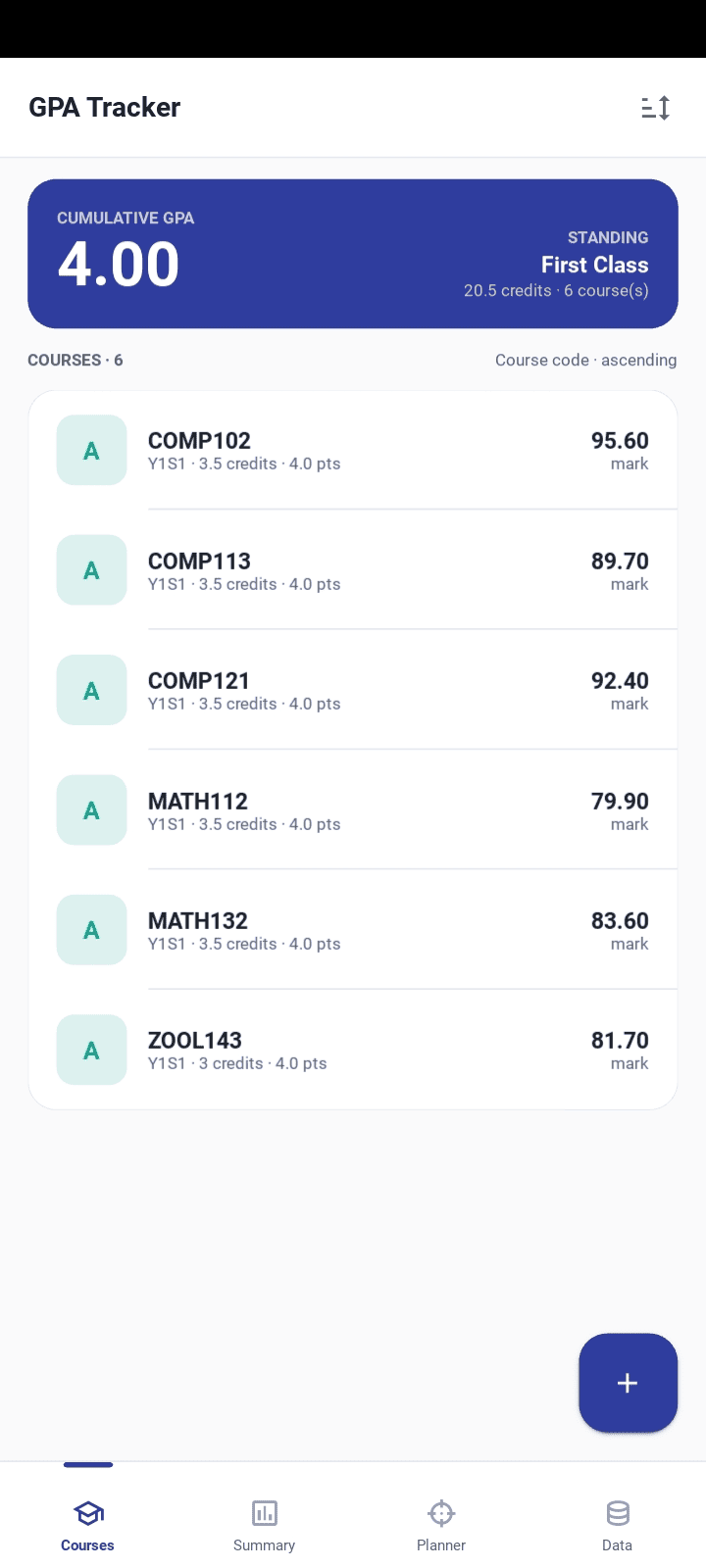
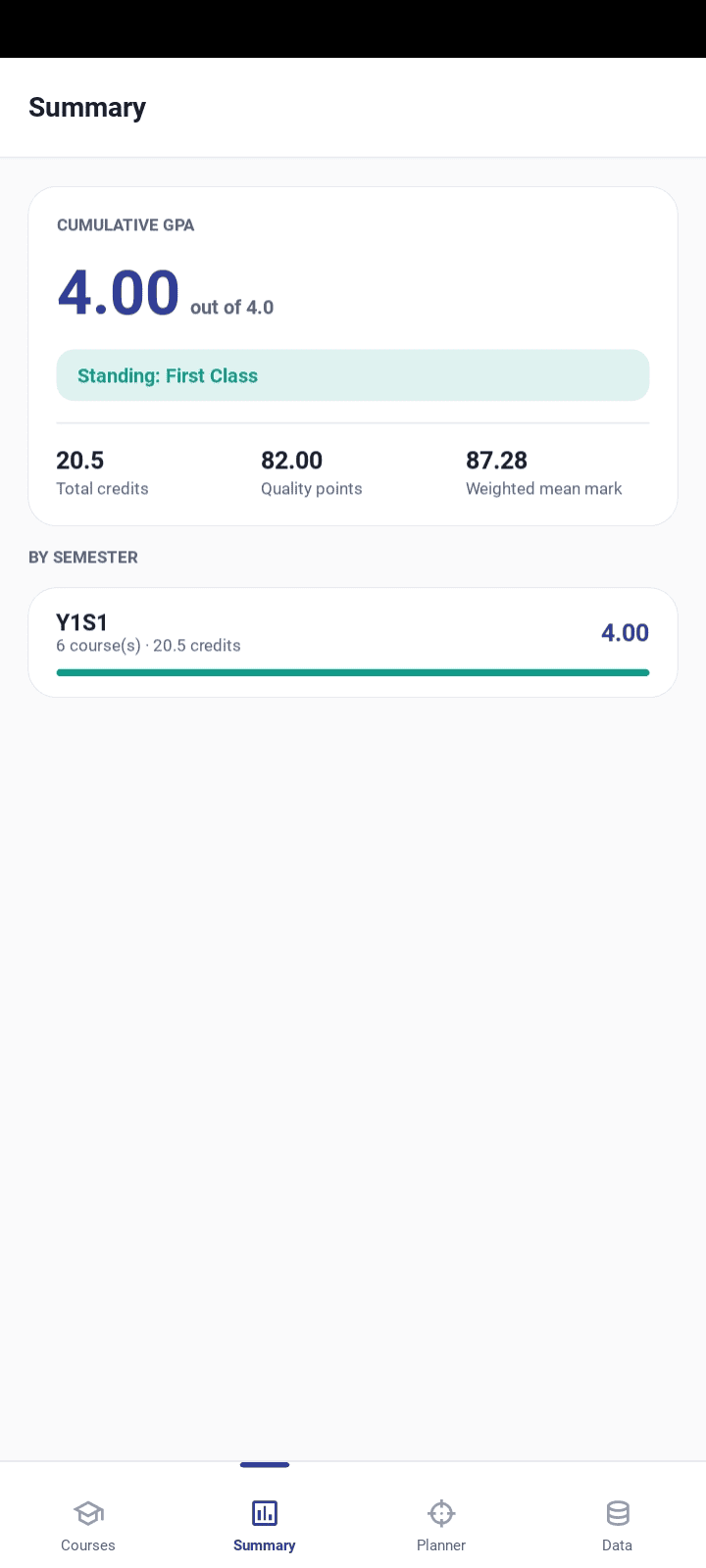
A personal project that records course marks by semester and reports final marks, letter grades, GPA and degree class using the grading rules in Egerton University’s 2020 regulations (section 16.4.1). The layout is designed for small phone screens. It is not an official university tool.
Screenshots
Problem addressed
Class boundaries are decided on a rounded mean, so a raw 59.995 already counts as 60. Floating-point numbers and banker’s rounding can get cases like that wrong, so the app calculates everything with exact decimals and half-up rounding.
Verified features
- 30/70 coursework-exam weighting, A to F grade bands, credit-weighted GPA, degree class and a discontinuation-risk rule.
- Edit-in-place for saved courses, keeping each record’s id and date added.
- Dated, integrity-checked database backups and a CSV export that opens in Excel and Google Sheets.
- Plain-language messages instead of raw crashes when the database file is corrupt, locked, read-only or missing.
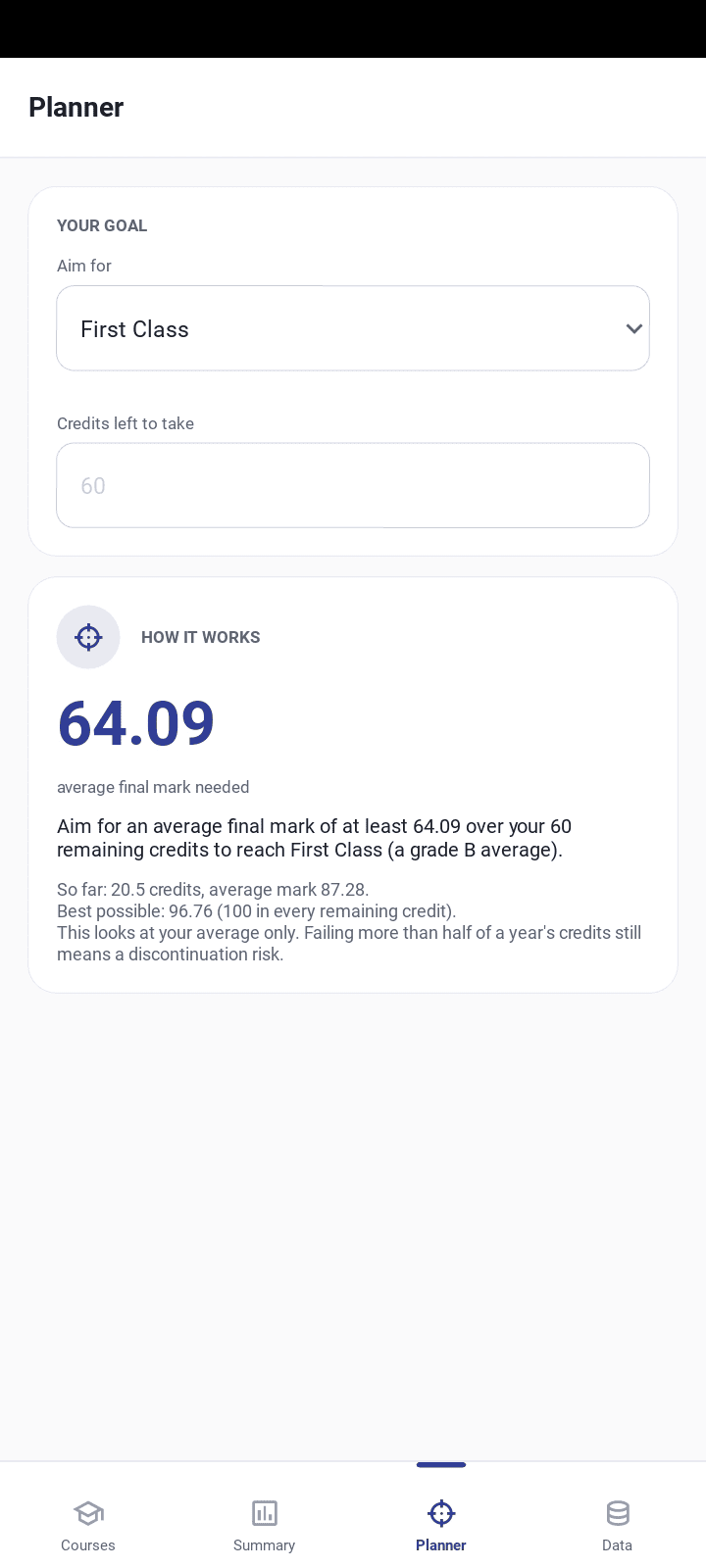
- A “what do I need?” planner that works out the average needed on the remaining credits to reach a target class or GPA.
Technologies
Python 3.13, Kivy 2.3.0 and KivyMD 1.2.0, SQLite (sqlite3), the decimal module, unittest.
Implementation approach
Twenty-one application modules (about 2,400 lines). Grading, validation, regrading, planning, sorting, exporting and error logic are kept free of GUI code; SQL lives only in database.py; the interface is a separate KivyMD layer (main.py, with its design tokens in theme.py). The logic modules need no Kivy, so their unit tests run without it.
Challenges and lessons
Six defects were found and fixed, four in the original app and two in code added later. Three are written up as case studies in the Journal: the Year 1 versus Year 10 match, grades that went stale, and a backup that could freeze.
Status and evidence
In progress: built as a personal project, not yet deployed and with no users. Checked with 564 automated checks (193 unit tests and 371 window-level checks written for the original interface and run against a stand-in for its toolkit) and mutation testing with 89 deliberately planted bugs. The layout has not been tried on a real phone.